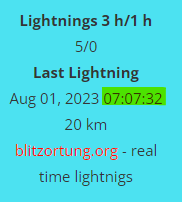
Following this morning’s lightning strikes, Station Master noted that Last Lightning time was displayed in UTC time instead of local time. This is now corrected.
Following this morning’s lightning strikes, Station Master noted that Last Lightning time was displayed in UTC time instead of local time. This is now corrected.
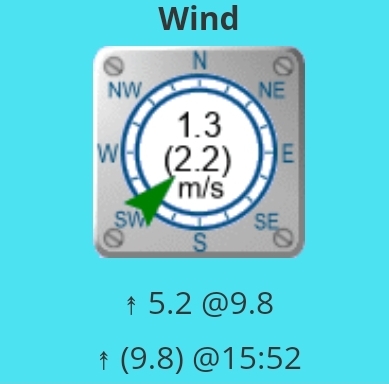
Weather Station Nagu’s wind gauge has changed. Now the 10 minute average wind and gusts are shown in one gauge, gusts being in parentheses.
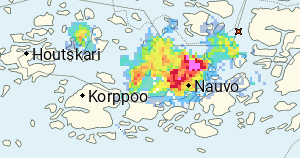
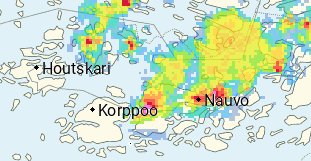
On Wednesday, July 19, 2023 WS Nagu witnessed a very local rainstorm. While writing this, it has been raining about an hour, with peak rate almost 100 mm/hour. Total rain will exceed 23 mm.
There was an outage that was due to a MicroSD card failure of one of the Weewx servers collecting and sending weather observation data to station’s web server. Actually, there has been three Raspberry Pi computers involved in the process, two running Weewx and one Home Assistant.
While fixing this, Station Master decided to simplify data collection and update method. Previously data was sent separately from Davis, Weatherflow and Growatt equipment to web server. Now, all data is collected to Home Assistant using HA’s integrations, and then sent to web server in JSON format in a single call.
Data update frequency is now one minute, instead of five minutes before this change.
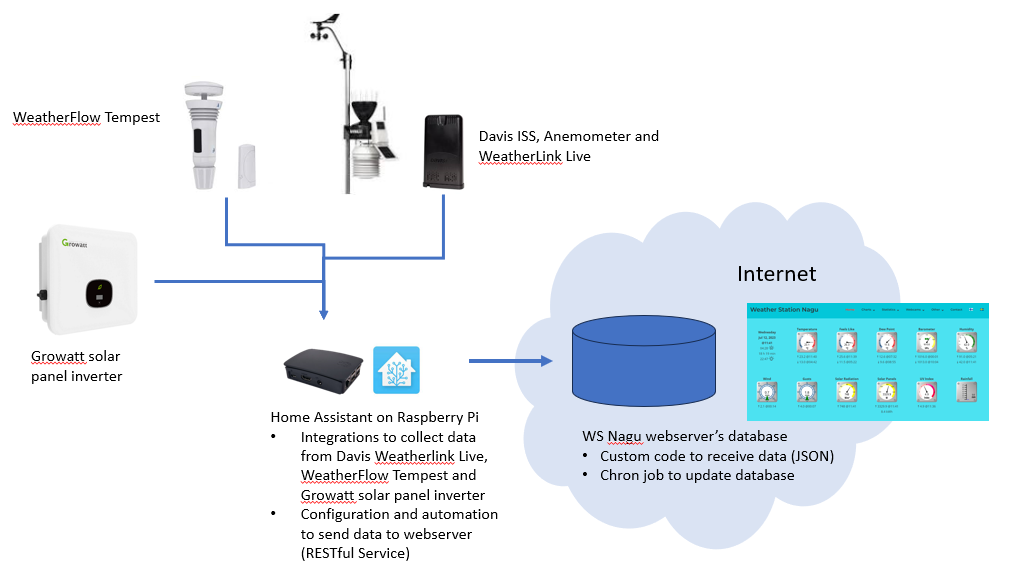
Home Assistant’s configuration is automatically backed up and backups are stored in cloud service. If there should happen a hardware failure, restoring the system is quite easy.
Station Master checked all links on Links page, fixed not working ones and removed obsolete links.
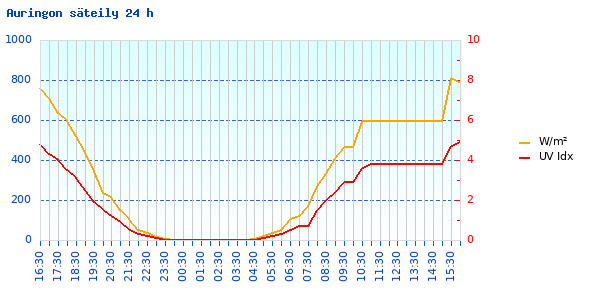
Today there was a few hours update failure of Solar Radiation and UV Index. They were not updated between 10.30 and 15. Issue was with weewx on Raspberry Pi.
New Davis Vantage Pro 2 equipment has been operational since April 6, 2023. Especially rain and wind measurement are now more accurate.
Regarding rain measurement, Tempest is not able to detect snowfall, and measurements were completely erratic during January-March this year. It turned out that main reason for this was bird repellent spike collar that was fallen from its normal place, and this caused erratic vibrations to haptic rain sensor. Also sonic anemometer was affected, so wind measurement was not reliable, too. Rain observations are removed from station’s database for period of January-March.
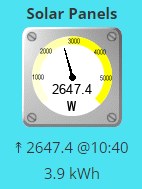
There is also a new gauge, Solar Panels showing house’s solar power plant’s current power and accumulated daily energy in kWh:
Weather Station Nagu started summer 2003 when Station Master decided to combine weather observation and computer software related hobbies and create a local weather station publicly available on Internet.
The original equipment was based on Davis Vantage Pro hardware. That equipment lasted over 15 years with quite a minimal maintenance, and parts of it are still working. During last 5 years I have experimented with different IoT based sensors, but currently, Weather Station Nagu is based on WeatherFlow Tempest hardware. While representing some advanced technology, Tempest’s biggest shortcoming is that it cannot measure precipitation accurately, at least in the environment it is located here.
But now, Weather Station Nagu just have received a brand new Davis Vantage Pro 2 hardware. Station Master will gradually set it up and update all related software, too providing weather data to station’s website. When everything is ready, new hardware will be switched to provide the current weather conditions and maintain the weather database.

Rain measurement is offline until Station Master gets a more reliable rain gauge than the current one is.
Weather Station Nagu’s house has now a solar power plant installed, with peak power 4,92 kWp. Station Master’s plan is to add current power production gauge and chart to weather station, as soon as integration issues are solved. Below a chart of solar power today by 14 o’ clock.

