
In this short video you can see the lower level clouds moving to the opposite direction than higher level clouds. The phenomenon causing this is called wind shear, vertical wind shear in this particular case. See more in Wikipedia.
Tekijä: Ari Rosti
Timelapse Videos
Weather Station Nagu will start publishing skycam timelapse videos on YouTube. Here is the first one, taken on June 6, 2020 which was quite a stormy day.
Anomaly in FMI Open Data
Today, we saw some very strange wind measurements at WS Nagu. At 10am, wind was 32700 m/s, and of course this affected to Feels Like temperature quite radically, too.

Charts show same measurements like this:


Problem was noted by FMI Open Data users widely. So far no official comment has been received from FMI. WS Nagu’s database will be corrected manually.
May Temperature Development
Compared to average temperature, May 2020 started quite normal. But after a week, temperatures went well below average. Comparison chart shows that last year the mid-May was actually very warm. Seems that summer waits itself this year longer than last year.

Outage Today
Today there was an outage that lasted somewhat three hours (about 2.30-5.30pm). Reason was fiber optic net maintenance work done by local network operator.

Weather observation values are stored in database of the station’s local server (weewx), but needs to be manually transferred to webserver’s database.
Flightradar24 Statistics
According to statistics of Flightradar24 receiver at Weather Station Nagu, amount of detected aircraft within about 400 km radius from Nagu has now stabilized to about 200 per day. It will be very interesting to see how relief of COVID-19 lockdown actions will affect and how quickly that will happen. After all, Finland is one of the important air traffic hubs to Far East, and economies are first recovering there.

Another interesting statistics shows the ideal location of the WS Nagu’s FR24 receiver. Rank of F-EFTU7 is 336th in global statistics and 3rd in Finland. While the maximum range has been 322 NM (596 km), the average range has been continuously about 220 NM (407 km).

It’s Snowing!

A good while ago, Station Master decided to switch off rain collector heater for this season. This morning that decision turned out to be a wrong one.
The heater is now on, but rain will be recorded some hours later than actually occurred. Probably it will not be correct, too. It should be about at least 6 mm by now.

WS Nagu’s Flightradar24 Receiver Ranked 3rd in Finland
After being online for a month, Flightradar24 receiver at Weather Station Nagu (F-EFTU7) is ranked the third best in Finland! Globally the rank is currently 509th among thousands of radars.
So the position is ideal. Maybe increasing the antenna mast height would improve rank further?

Fixing ISS Transmitter Failed
Station Master replaced the failing transmitter today with a spare part obtained from a friend’s obsolete Vantage Pro. That transmitter seems to work as should, which is great news!
Then, the idea was to service the original transmitter by replacing the obvious reason to increased battery consumption, failed superconductor. After opening the cover, it was quite clear that the conductor couldn’t work at all. In fact, the other leg of it had severely corroded and was completely broken. See the image below.

Removed the superconductor and tried to clean the connectors. Then, because there is another, neat place for conductor, soldered a brand new one there. Cleaner connectors was the idea.


Looks good, don’t you think? But… battery inserted–and nothing happened. Switched on the dip to flash the test led. Nothing. Completely dead circuit board.
At this stage checked that the superconductor +/- poles were correct. They were. Then removed the conductor (the board should work even without it). Nothing. Just to be sure, soldered the conductor to the original position (this was not going to help, but anyway…).
So something has happened to the circuit board itself during this attempt to fix it. More electronics oriented person might be able to troubleshoot the board further, but Station Master’s abilities do not allow that.
So let’s hope, that the spare transmitter works (and does not require replacing battery every other day) until the new WeatherFlow station arrives. And who knows when that will happen, given the current circumstances?
Well, after all, considering everything what’s happening globally, troubles with a some remote weather station are not the most pressing ones. But at least this gave Station Master a chance to think something else for a while!
Component Causing Trouble
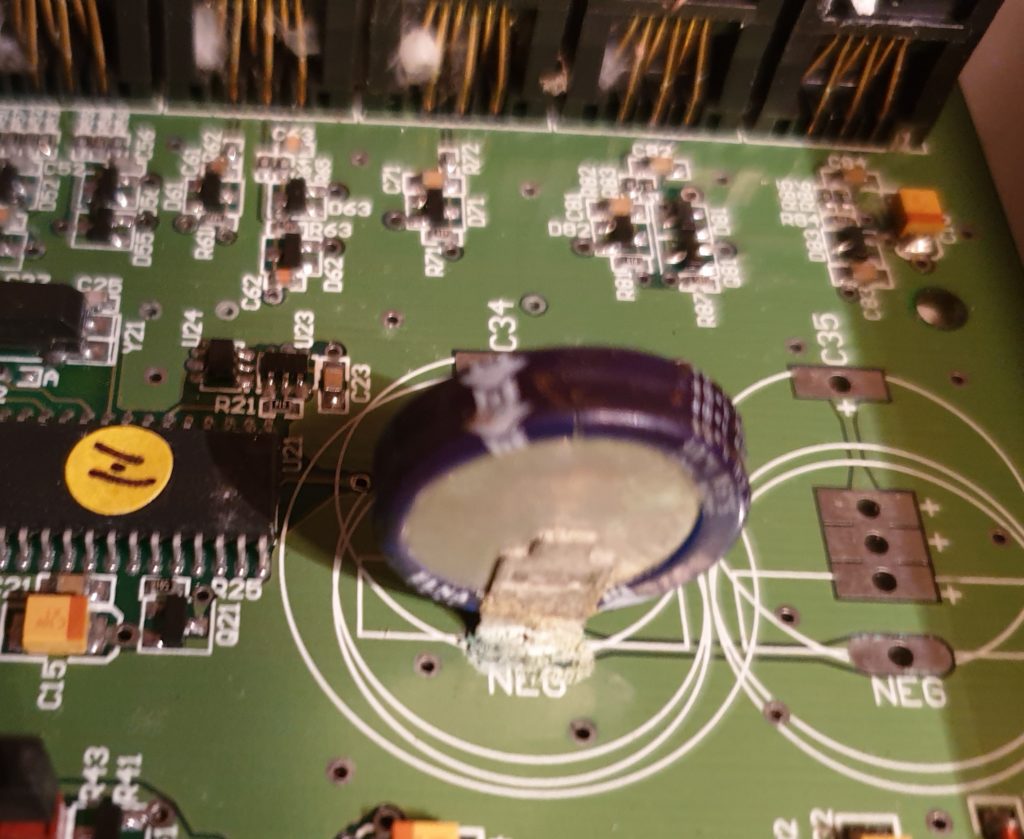
Troubleshooting of the ISS transmitter has proceeded. Probably the faulty component is this shown in the image.